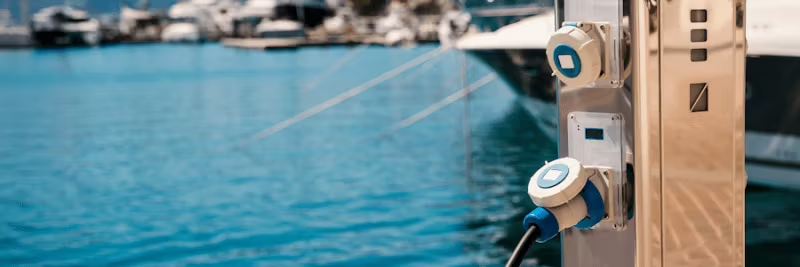
How to properly ground on board: tips, rules, and best practices to avoid risks and protect your equipment.
Are you looking for information on grounding in boats and how to achieve a safe electrical system on board? A correctly performed electrical installation on a boat is crucial to avoid electric shocks, fire hazards, and galvanic corrosion. In this guide, you will learn how to protect your boat with proper grounding, why a residual current device is a must, and how to use modern solutions like Victron MultiPlus and Quattro for maximum safety according to ISO 13297.
You will learn, among other things:
- The basics of grounding and how to protect the boat from galvanic corrosion.
- How and where to install a residual current device for best personal protection.
- Smart inverter solutions to get 230V on board even without shore power.
- The benefits of Victron MultiPlus and Quattro – automatic switching and protection against backfeeding.
- Why ISO standards are crucial for safe electrical installation on a boat.
The goal is to give you a complete overview so you can build an electrical system that is both safe and future-proof according to current regulations and ISO standards.
Why is grounding important in a boat?
- Personal protection: Grounding reduces the risk of electric shock by diverting fault currents.
- Protection against galvanic corrosion: Connect metal components to a grounding plate and sacrificial anode to protect the hull.
- Stable electrical system: Grounding provides a reference point for electrical circuits and reduces interference.
Common solution: Install a grounding plate in the hull and connect it to the engine, battery, and distribution panel. Use sacrificial anodes to absorb corrosion attacks.
How is the anode connected correctly?
The hull anode should be connected to the same grounding system (ground loop) as other metal components in the boat. This is important to:
- Create a common potential between the hull, engine, propeller shaft, and other metal parts.
- Protect against galvanic corrosion by having the anode absorb the current instead of the hull.
- Reduce the risk of stray currents that can occur if different parts have separate grounding points.
How to do it:
- Connect the anode to the ground loop with a short, thick cable (same dimension as other ground wires).
- Ensure the connection is clean and corrosion-free – use grease or protection against oxidation.
- Check that the ground loop is connected to the grounding plate in the hull and that all metal parts are included in the circuit.
⚠ Important: The anode should not be connected directly to the battery's negative terminal but via the grounding system, otherwise you risk galvanic problems.
Residual current device – where and why?
A residual current device is a must in all boats with 230V systems. It should:
- Be installed at the shore power inlet or in the electrical panel before the current goes to outlets and appliances.
- Protect the entire system by interrupting the current in case of leakage currents (30 mA is standard for personal protection).
Why?
- Prevents electric shock in damp environments.
- Reduces fire risk in case of fault currents.
- Complies with ISO standards and the EU Recreational Craft Directive.
Tips:
- Test the residual current device regularly.
- Use a qualified marine electrician for installation.
Inverter in the boat – how does it work when shore power is disconnected?
An inverter makes it possible to use 230V on board even without shore power:
- Converts the battery's DC current (12/24/48V) to AC current (230V).
- Automatic switching: On advanced systems, the transition from shore power to inverter operation occurs automatically.
- Charging: When shore power is available, the inverter charges the batteries. When disconnected, the inverter powers 230V equipment from the batteries.
Important:
- No backfeeding to the shore power inlet – use a switch or relay.
- The residual current device should also protect the inverter circuit.
- Battery capacity limits how long you can run heavy appliances.
Victron MultiPlus and Quattro – managing backfeeding
Victron Energy has developed advanced solutions for marine electrical systems. MultiPlus and Quattro are popular for their flexibility and safety.
How it works:
- Internal transfer switch: When shore power is connected, AC goes directly to the load and the batteries are charged. When shore power is disconnected, the unit switches to inverter mode.
- Backfeeding protection: Built-in relays disconnect the AC input when it is not active, preventing power from being sent back to the shore power grid.
- PowerAssist: With limited shore power, the unit can provide battery power to avoid overload – without feeding back to the grid.
Follow ISO standards and hire a qualified electrician
Following international ISO standards is crucial for safety on board. For boats, the following apply in particular:
- ISO 13297 – regulates the installation of shore power systems (AC/DC).
- ISO 10133 – applies to low-voltage systems (12/24/48V).
These standards ensure that:
- Grounding and protective conductors are correctly dimensioned and installed.
- Residual current devices meet the requirements for personal protection (30 mA trip current).
- Separation between AC and DC systems is clearly defined.
- Cabling and materials are adapted for marine environments (moisture, salt, vibrations).
A qualified marine electrician:
- Has knowledge of applicable ISO standards and national regulations.
- Ensures that the installation is correct and that all protections work as they should.
- Can dimension the system according to your boat's needs and check that grounding, inverter, and shore power connection are safe.
Summary – how to build a safe electrical system in your boat
- Ground all metal components to a grounding plate in the hull.
- Install sacrificial anodes for corrosion protection and connect them to the ground loop.
- Install a residual current device at the shore power inlet.
- Use an inverter for 230V when shore power is unavailable – with correct switching and protection.
- Choose advanced solutions like Victron MultiPlus or Quattro for automatic switching and safe operation.
- Follow ISO standards and hire a qualified electrician to guarantee safety and longevity.

 Svenska
 Dansk
Dansk
 Suomi
Suomi
 Español
 Deutsch
 Français
 Italiano
 Nederlands
 Polskie
 Norsk
Norsk