
 Svenska
 Dansk
Dansk
 Suomi
Suomi
 Español
 Deutsch
 Français
 Italiano
 Nederlands
 Polskie
 Norsk
Norsk
Cart
Your cart is empty, but doesn't have to be..
Discount: 0.00 EUR
Justin, Victron Energy |12/10, 2020
We've also wondered about that question – so we decided to conduct a completely impartial test.
This isn't about proving that Victron panels are the best. We simply wanted to compare different technologies:
To get a fair result, we installed four identical solar power systems outdoors, with the same conditions:
The power has been mathematically recalculated so that the results correspond to a system of 2500 Wp.
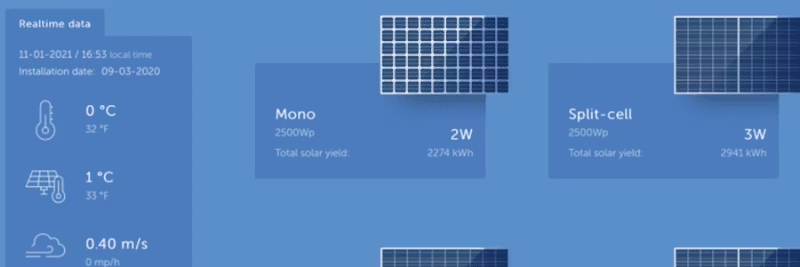
The test has been ongoing for six months and continues. You can follow live data and see the total energy production over time.
When monocrystalline panels produced 1430 W, the comparison looked like this:
What makes the test interesting is that different panel types perform best under different weather conditions. Therefore, local weather data is displayed along with the panels' measurements.
Right now, we are heading towards winter in the Northern Hemisphere. Clear, cold days with strong sun are perfect for solar energy – so it will be exciting to see the results!
Want to follow the test? Go to Victron Energy and click on Field Test (top left of the black menu bar). Please note that the function is not yet available on mobile.
Also watch our video showing how we built the four panel systems and how you can compare the results: