Svenska
 Dansk
Dansk
 Suomi
Suomi
 Español
 Deutsch
 Français
 Italiano
 Nederlands
 Polskie
 Norsk
Norsk
Cart
Your cart is empty, but doesn't have to be..
Your cart is empty, but doesn't have to be..

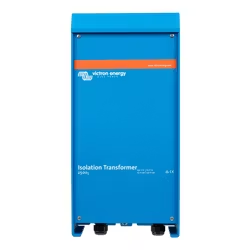
VICTRON ENERGY ITR000702001, is an isolation transformer that is indispensable in professional marine electrical systems.
The product is unfortunately out of stock.
VICTRON ENERGY ITR000702001, is an isolation transformer that is indispensable in professional marine electrical systems. An isolation transformer provides two separate electrical circuits, galvanically separating the AC systems between the shore power and the boat. This is important for safety and eliminates the need for galvanic isolators and polarity reversal alarms.
Galvanic corrosion occurs when two different metals are in contact with each other and exposed to an electrically conductive liquid. Seawater and freshwater, though to a lesser extent, are such liquids. Generally, the more active (base) metal corrodes while the less active (noble) metal receives cathodic protection. The degree of corrosion depends on several factors such as the ratio of the metal surface areas, the corrosive properties of the liquid and metals, etc.
It is a misconception that galvanic corrosion only affects metal and aluminum hulls. In fact, it can affect any boat as soon as a metal part (shaft and propeller) comes into contact with water. When the boat is connected to shore power, galvanic corrosion will quickly destroy your sacrificial anodes and corrode the shaft, propeller, and other metal parts in contact with the water. It can therefore be tempting not to connect the earth wire, but this is nevertheless very dangerous because an RCD will then not function, nor will a fuse blow in the event of a short circuit to the boat's metal parts.
The best solution to avoid galvanic corrosion and at the same time avoid this unsafe situation is to install an isolation transformer to which the shore power is then connected.
Safety and protection against galvanic corrosion
With an isolation transformer, you get two separate electrical circuits; the AC systems are galvanically separated between the shore supply and the boat. This is important for safety and eliminates the need for galvanic isolators and polarity reversal alarms. We consider safety to be self-evident when it comes to ordinary land installations. In the event of a short circuit, the fuse "blows", and in the event of an earth fault, the RCD trips. If you connect the shore-side earth wire to the boat's metal parts, you get galvanic corrosion (see below). If you only connect the phase and neutral conductors to the boat's electrical system, you create a dangerous situation because an RCD will then not function, nor will a fuse blow in the event of a short circuit to the boat's metal parts.
Galvanic corrosion occurs when two different metals are in contact with each other and exposed to an electrically conductive liquid. Seawater and freshwater, though to a lesser extent, are such liquids. Generally, the more active (base) metal corrodes while the less active (noble) metal receives cathodic protection. The degree of corrosion depends on several factors such as the ratio of the metal surface areas, the corrosive properties of the liquid and metals, etc.
It is a misconception that galvanic corrosion only affects metal and aluminum hulls. In fact, it can affect any boat as soon as a metal part (shaft and propeller) comes into contact with water. When the boat is connected to shore power, galvanic corrosion will quickly destroy your sacrificial anodes and corrode the shaft, propeller, and other metal parts in contact with the water. It can therefore be tempting not to connect the earth wire, but this is nevertheless very dangerous because an RCD will then not function, nor will a fuse blow in the event of a short circuit to the boat's metal parts.
The best solution to avoid galvanic corrosion and at the same time avoid this unsafe situation is to install an isolation transformer to which the shore power is then connected. With an isolation transformer, you get two separate electrical circuits; the AC systems are galvanically separated between the shore supply and the boat. The shore power is connected to the primary side of the transformer and the boat's system to the secondary side. The isolation transformer separates the boat from the shore system's protective earth. By connecting all metal parts to the neutral on the secondary side of the transformer, RCDs and fuses will trip in the event of a short circuit.
Soft start is standard on isolation transformers from Victron Energy. It prevents the transformer's inrush current from tripping the shore fuse.
It is also advisable, for best safety, to connect the neutral of the secondary side to protective earth when the boat is ashore.
3600 Watt Auto 115/230 V
This model automatically switches to 115 V or 230 V, depending on the incoming voltage. Power supply 88 V – 130V: switches to 115 V supply Input 185 – 250 V: switches to 230 V input range. Note: The AC input voltage increases by a ratio of 1:1.05 at the AC output.
Good product-related links