Cart
Discount: 0.00 DKK
Discount: 0.00 DKK
Digital Skipper |1/04, 2024
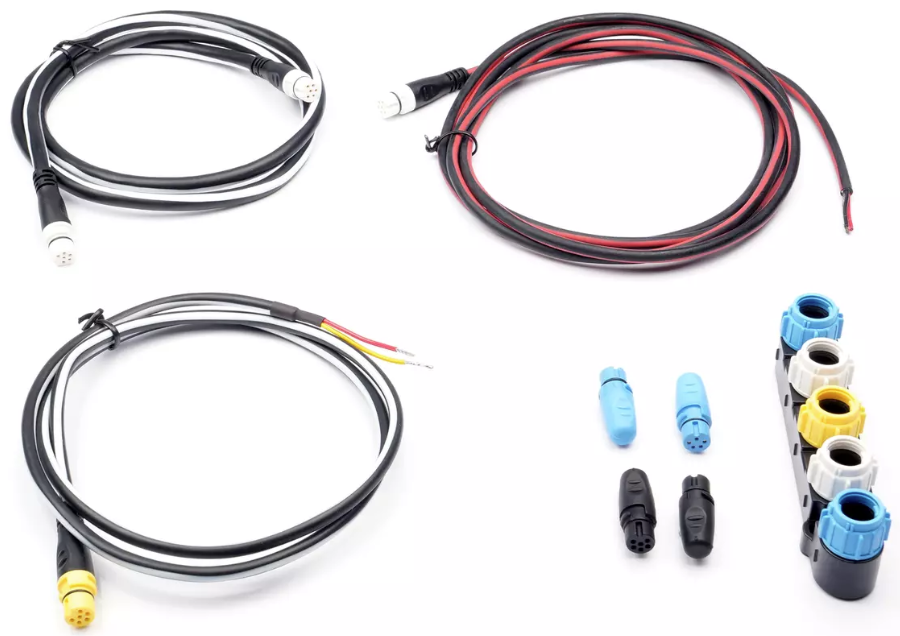
After the introduction of GPS units with STng or NMEA 2000 connection, it was realized that many customers had DSC VHF radios, single-band radios, etc. that required 4800 BAUD NMEA 0183 GPS data sentences to support the operation of these units. Some of these customers did not have a 4800 BAUD source for GPS data to meet this requirement. In response, Raymarine introduced a feature within the v1.21 SeaTalk to SeaTalkng Converter software update that allows a SeaTalk to SeaTalkng Converter to transmit a limited set of 4800 BAUD NMEA 0183 GPS sentences. Raymarine has subsequently introduced the E70196 VHF NMEA 0183 to STng Converter Kit (shown below).
The SeaTalk to SeaTalkng Converter will transmit the following 4800 BAUD NMEA0183 v4.10 sentences:
After the software update, the SeaTalk to SeaTalkng Converter will operate in "Sense Mode" for the first twenty seconds. If first-generation SeaTalk communication packets are detected during Sense Mode, the SeaTalk to SeaTalkng Converter will function as a SeaTalk to SeaTalkng Converter. If no first-generation SeaTalk communication packets are detected during Sense Mode, the SeaTalk to SeaTalkng Converter will instead function as a one-way partial SeaTalkng/NMEA 2000 data bridge, transmitting the aforementioned NMEA 0183 GPS sentences with $GP Talker ID at 4800 BAUD.
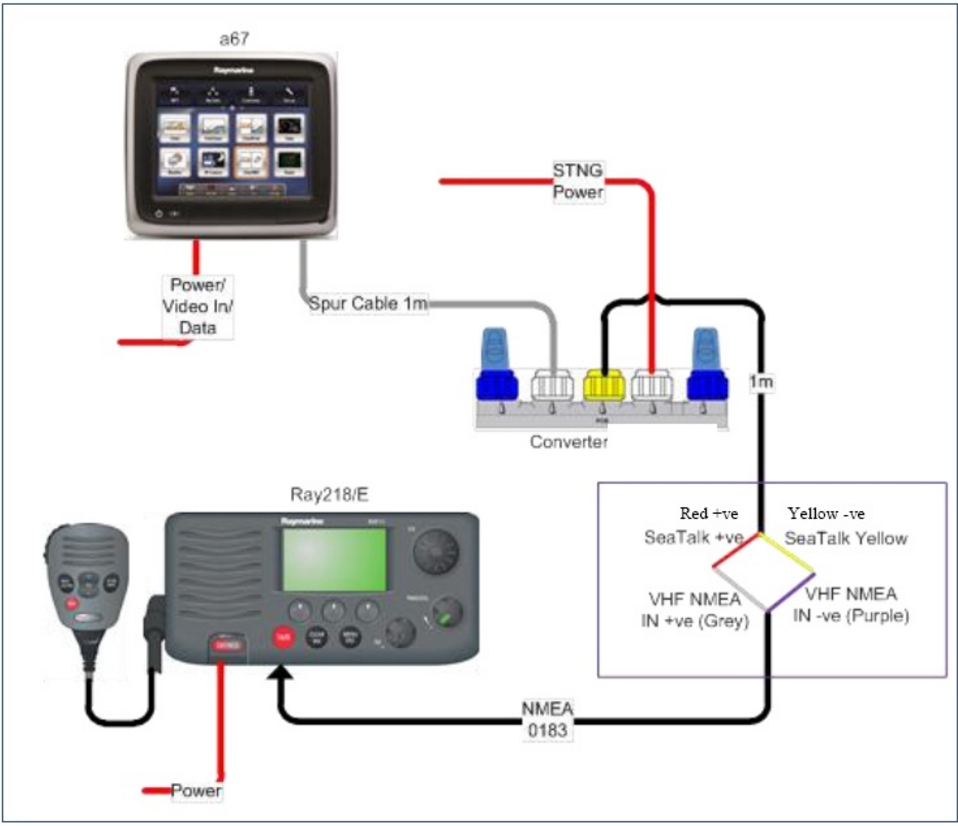
The diagram below illustrates how a SeaTalk to SeaTalkng Converter can be used to provide GPS data from an a67 MFD to a DSC VHF radio that requires such data from a 4800 BAUD NMEA 0183 source. GPS data from a Raystar 130 or other SeaTalkng/NMEA 2000 data source can similarly be provided to a DSC VHF radio using the SeaTalk to SeaTalkng Converter.
Note: According to international agreement, DSC VHF radios should be connected to a source of GPS data when in use. In accordance with this agreement, DSC VHF radios will emit a NO FIX alarm at regular intervals when the VHF radio is not receiving GPS data via its NMEA 0183 or SeaTalkng/NMEA 2000 communication interface. DSC VHF radios have a function that allows manual input of the vessel's position. This function is intended only for emergencies if the VHF radio's source of GPS data has failed.
Note: The solution mentioned above also applies to Axiom MFDs (not to be confused with Axiom Pro and Axiom XL MFDs) and Element displays. Since the NMEA 0183 communication interface for Axiom MFDs and Element displays has a DeviceNet connector instead of a SeaTalkng connector, an A06075 39.4 inch (1.0 m) DeviceNet (F) to SeaTalkng Spur Adapter can be used to connect an Axiom MFD to a SeaTalkng spur connector.
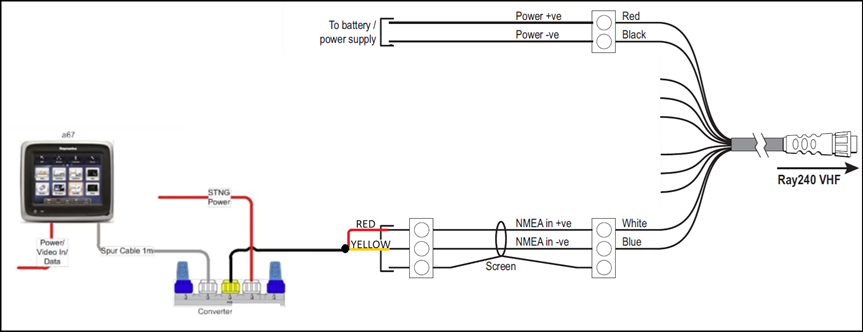
Many customers want to monitor DSC VHF radio communications while at anchor, docked, etc., but do not want the extra power consumption from an MFD. Such customers are recommended to