
 Svenska
 Dansk
Dansk
 Suomi
Suomi
 Español
 Deutsch
 Français
 Italiano
 Nederlands
 Polskie
 Norsk
Norsk
Cart
Your cart is empty, but doesn't have to be..
Discount: 0.00 EUR
Digital Skipper |14/11, 2022
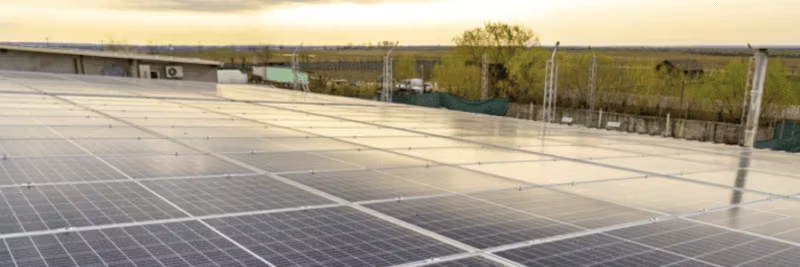
Are you considering installing solar panels on your boat, caravan, RV, summer cabin, villa, or property? Or have you already installed them and are unsure if everything was done correctly? This guide clarifies the concepts and provides concrete tips for a safe and efficient installation.
Interest in solar energy is enormous right now, but a solar cell system requires correct sizing and an understanding of concepts such as voltage, power, battery bank, and controllers. Here you get a complete overview.
Before we delve into the technology, it's important to understand how solar energy varies throughout the year. The example below shows production in Stockholm. Most energy is produced in April–May when the sun is strong and the temperature is cool, which increases panel efficiency. During November–February, production is only about 25% of summer levels.

The battery bank stores energy from the solar panels. For charging to start, the panel voltage must exceed the battery voltage by approximately 5V. This is easy for 12V systems but requires careful sizing for 48V systems.
Lithium batteries are significantly more efficient than lead-acid batteries (AGM, GEL) and charge faster. Read more in our guide: Optimize property energy with Victron ESS system.
The controller acts as a battery charger that manages the energy from the panels. Size it according to the panels' maximum power (Volts and Amperes). Victron Energy offers an MPPT calculator that helps you calculate the correct controller based on panel data, battery voltage, and cable length.
Tip: Victron SmartSolar controllers have Bluetooth (BT) for easy monitoring, while BlueSolar lacks BT.
Choose panels from reputable Manufacturers – it pays off over time. It is important to check the panel's maximum system voltage. Victron framed panels can handle up to 1000V, while flat panels for gluing often have a lower limit.
Parallel connection provides the same system voltage but higher total power. Perfect for different shading conditions. Always use the same panel model and thicker cables to avoid power losses.

Series connection is used for higher system voltage (24V or 48V battery bank). Check that the panels have a built-in bypass diode or supplement with external diodes. Victron panels have integrated bypass diodes.

In larger installations, series and parallel connections are combined for optimal voltage and power. The number of panels is limited by the controller's specifications.

Solar panels are always live in daylight – secure the system with automatic fuses and main switches. Fuses are placed between the panel and the controller, and between the controller and the battery. Use MC4 connectors for waterproof connections.
Calculate cable dimension with the Victron MPPT calculator or the Victron Toolkit app. Read more in our guide: Which cable dimension should you use?.