
 Svenska
 Dansk
Dansk
 Suomi
Suomi
 Español
 Deutsch
 Français
 Italiano
 Nederlands
 Polskie
 Norsk
Norsk
Cart
Your cart is empty, but doesn't have to be..
Discount: 0.00 EUR
Digital Skipper |18/11, 2025
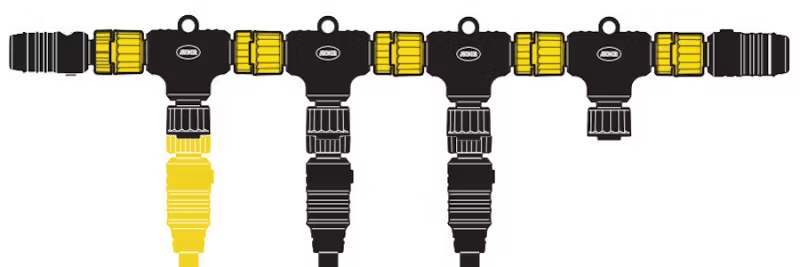
NMEA 2000 has become the backbone of marine electronics, where everything from sensors to plotters and batteries can communicate on a single network. But when it comes to power supply, there's an important detail that many miss – and which can be costly if done incorrectly.
According to the NMEA 2000 standard, the network should be powered with 9–16V DC, which in practice means you should always use 12V as the system voltage. All certified NMEA 2000 products are built to operate within this range. If you connect a higher voltage, you risk damaging both the network and connected devices.
Some manufacturers, such as Actisense and Maretron, have chosen to build their products to handle higher voltage – sometimes up to 24V or more. This can be practical on boats with 24V systems, but it is not according to the NMEA 2000 standard. This means that even if an individual product can handle 24V, other devices on the network could be damaged. Cables and connectors are also often rated for a maximum of 3A and 16V, and higher voltage can lead to overheating and fire risk.
Although some products on the market can handle 24V, 12V is always the standard for NMEA 2000 networks. It is the only safe way to avoid damage, operational disturbances, and costly repairs. Invest in the correct voltage – and you will get a stable and future-proof network on board.