
 Svenska
 Dansk
 Suomi
 Español
 Deutsch
 Français
 Italiano
 Nederlands
 Polskie
 Norsk
Cart
Your cart is empty, but doesn't have to be..
Your cart is empty, but doesn't have to be..
Digital Skipper |22/10, 2026
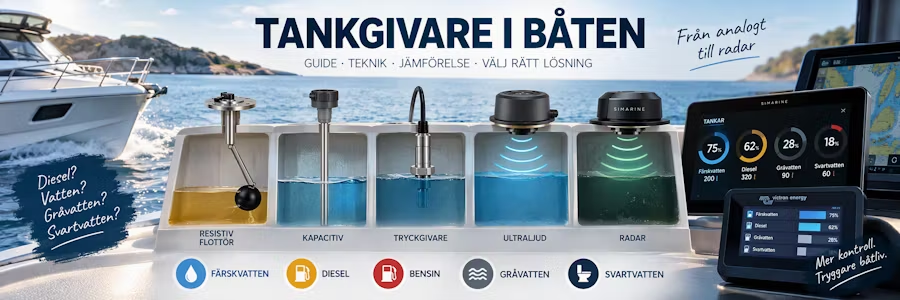
Most tank sensors do not actually measure how many liters are in the tank. Instead, they measure, for example, liquid height, distance to the liquid surface, pressure, resistance or capacitance. The system then converts the measured value to a percentage or liters.
On a rectangular tank the relationship is simple. But many boat tanks follow the shape of the hull and can, for example, be significantly narrower at the bottom than at the top. In this case, 50 percent liquid height does not necessarily mean that 50 percent of the volume remains.
Therefore, good calibration can be at least as important as the sensor's measurement precision.
Resistive tank sensors have been used on boats for decades and are still very common for fuel and water.
A float follows the liquid surface and changes the electrical resistance of the sensor. Common designs are a float at the far end of a moving arm or a vertical sensor where the float moves along a tube or rod.
The technology is cheap, proven and relatively easy to troubleshoot. The disadvantage is primarily the mechanical parts. The float can seize, wear out or be affected by deposits.
A resistive sensor doesn't have to involve an old-fashioned tank system. The intelligence can instead lie in the electronics that read the signal.
For example, Victron Cerbo GX can read resistive tank sensors and integrate the levels with the boat's other monitoring. The tank information can also be distributed over NMEA 2000.
Simarine offers a similar opportunity through, among others, SCQ25T and PICO.
With modern electronics and calibration, it is also possible to compensate for an irregularly shaped tank and thus get a better estimate of the actual volume.
Therefore, do not replace a working tank sensor just because you want to modernize tank monitoring.
For diesel and fresh water, a traditional resistive sensor can still be a very good choice.
Capacitive sensors measure level through changes in electrical capacitance and can be constructed without moving parts.
There are also solutions that, under the right conditions, can sense the liquid level through the wall of, for example, a plastic tank. This eliminates the need for mechanical components to be mounted inside the tank.
However, the technology is dependent on the properties of the liquid, tank material and wall thickness. The right sensor must therefore be selected for the specific installation.
Hydrostatic sensors measure the pressure from the liquid column above the sensor. The higher the liquid level, the higher the pressure.
The technology has no moving parts, works well even in deep tanks and does not require a clear view of the liquid surface.
The disadvantage is that the sensor or pressure connection normally comes into contact with the liquid. The density of the liquid also affects the relationship between pressure and level.
Pressure sensors can therefore be a good alternative for, for example, fresh water and diesel, but are less attractive where dirt and deposits are a major problem.
An ultrasonic sensor is mounted on the top of the tank and sends a sound pulse towards the liquid surface. By measuring the time it takes for the echo to return, the system can calculate the level.
Maretron TLM100 is an established example and can be used for diesel, fresh water, wastewater, black water and oil, among other things.
The big advantage is that no float or long dipstick needs to be in the liquid.
The disadvantage is that the sensor needs a clear echo. Foam, tank construction, internal obstructions and the boat's tilt can affect the measurement. Ultrasonic transducers also have an area closest to the sensor where the measurement is limited, a so-called dead zone.
Radar also works with reflections, but uses electromagnetic waves instead of sound.
The technology is particularly interesting where foam, gases, dirt and coatings can cause problems for other measurement principles. Modern radar sensors have also become small enough to be interesting even on recreational boats.
Among the interesting options are Simarine STR1 and STR2 as well as Safiery STAR-Tank.
STR1 uses radar to measure the level without a mechanical float down in the liquid, but can be integrated with systems built for traditional analog tank sensors.
This makes STR1 particularly interesting when you want to switch to contactless measurement without having to rebuild the entire tank monitoring system.
STR2 is instead based on direct integration with NMEA 2000.
It is attractive in a modern installation where tank information should be displayed on a compatible navigator or other NMEA 2000 display.
The difference between STR1 and STR2 shows something important: the choice is not only about how the level is measured, but also about how the information is passed on to the rest of the boat .
Safiery STAR-Tank also uses radar but has chosen a different system solution.
The sensor is battery powered and sends tank information wirelessly via Bluetooth to a compatible Victron GX system.
On some non-metallic tanks, the sensor can also be mounted externally on the top of the tank.
In the correct installation, this can mean:
No float, no dipstick, no signal cable to the tank and in some cases no drilling.
There are different solutions for water, wastewater and fuel, so the installation requirements of the current model always need to be checked.
Simarine and Safiery illustrate three interesting ways to use the same basic measurement technique.
The Simarine STR1 uses radar but can be integrated with a system that expects a more traditional tank sensor.
Simarine STR2 uses radar and sends tank information directly to NMEA 2000.
Safiery STAR-Tank uses radar and instead sends the information wirelessly to Victron GX.
Which solution is best therefore depends a lot on what electronics are already on board.
Fresh water is relatively easy to measure and most techniques work well.
In a standard rectangular tank, a traditional resistive or capacitive sensor is often sufficient. Radar is particularly interesting if you want to avoid components inside the tank or simplify installation.
Our verdict: Keep it simple if the idea is simple.
For diesel, good calibration becomes more important because fuel tanks are often irregularly shaped and follow the hull.
Traditional resistive sensors still work well, while ultrasonic and radar offer non-contact measurement.
The Maretron TLM100 uses ultrasound while the Simarine STR1 and STR2 are examples of radar-based alternatives.
Our assessment: Prioritize operational reliability and good calibration, not just the most advanced measurement technology.
For gasoline, safety comes first.
A sensor that works with diesel or water is not automatically suitable for petrol. The specific product must be designed for petrol tanks and installed according to the manufacturer's instructions.
For example, the Maretron TLM150 is an ultrasonic sensor specifically designed for gasoline tanks.
Our assessment: Always check the specific product's intended use before installing it in a gas tank.
Greywater can contain soap, grease, hair and other contaminants that can affect mechanical sensors over time.
This is where contactless measurement becomes significantly more attractive.
Our assessment: Ultrasound or radar are often better alternatives than a mechanical float.
The septic tank is perhaps the clearest area of application for contactless tank measurement.
Paper, waste and coatings create a difficult environment for mechanical parts. With radar or ultrasound, the measurement can instead be done from the top of the tank.
Our assessment: Start by looking at radar or ultrasound.
It is easy to believe that a NMEA 2000 sensor automatically measures better than an analog sensor.
That's not the case.
NMEA 2000 is primarily a way to transport information:
Tank → transducer → calibration → NMEA 2000 → display
For example, Maretron TLM100 and TLM150 use ultrasound for the measurement itself and then send the tank information over NMEA 2000. Simarine STR2 uses radar for the measurement and NMEA 2000 for the distribution of the information.
A traditional resistive sensor can also provide very useful information if the sensor is working well and the system has good calibration capabilities.
Resistive sensor
A simple, affordable and well-proven alternative for fresh water and diesel in particular. The disadvantage is mechanical components in the liquid.
Capacitive sensor
Lacks moving parts and can accommodate both water and fuel. Tank material, fluid and installation are of great importance.
Pressure sensor
Good for example fresh water and diesel and also works in deep tanks. The sensor normally comes into contact with the liquid.
Ultrasound
Non-contact measurement that works for many tank types. Foam, slope, internal obstacles and dead zone can affect the result.
Radar
Non-contact technology that is particularly interesting for grey and black water but can also be used for water and fuel with the right product. Installation and tank material must be considered.
Gasoline is a special case. Regardless of the measurement technology, a product that is specifically designed for gasoline should be used.
If you want to connect the tank sensor directly to NMEA 2000, the Maretron TLM100 is an example with ultrasound, while the Simarine STR2 uses radar.
If you want to modernize an older analog installation, it may be wise to first keep the existing resistive sensor and connect it to modern electronics. If you also want to change the measurement itself to radar, the Simarine STR1 is an interesting alternative.
If the boat already has a Victron Cerbo GX, existing compatible resistive sensors can be used directly. For sensors with other signal types, there is the Victron GX Tank 140.
If you instead want wireless radar measurement integrated with Victron GX , the Safiery STAR-Tank is an interesting solution.
The most advanced fuel gauge is not automatically the best.
For a simple fresh water tank, a traditional resistive sensor can work perfectly. If the boat already has working sensors, modern electronics can also provide better presentation and calibration without the need to rebuild the tanks.
For diesel, the shape of the tank and the possibility of good calibration are particularly important.
For greywater and especially blackwater, non-contact radar and ultrasound have greater advantages because mechanical components do not have to be in the dirty liquid.
Radar is a particularly interesting development. The Simarine STR1 shows how radar can be used to modernise a more traditional installation, while the STR2 fits into a NMEA 2000 system. Safiery shows a third way through wireless integration with Victron GX.
So instead of asking:
Which fuel gauge is best?
is it better to ask:
Which sensor is best suited for the liquid, the shape of the tank and the electronics already on board?
Simple fresh water tank: Start with a resistive or capacitive sensor.
Existing working tank sensor: Keep it if possible and integrate it with modern electronics.
Switching from traditional transducer to radar: Take a look at the Simarine STR1, for example.
Radar directly to NMEA 2000: Simarine STR2 is an interesting option.
Ultrasonic directly to NMEA 2000: Maretron TLM100, or TLM150 for gasoline.
Diesel: Resistive sensor, ultrasonic or radar can work well. Pay great attention to calibration.
Gasoline: Only use a product specifically designed for gasoline tanks.
Greywater: Start by looking at ultrasound or radar.
Blackwater/Septic: Radar or ultrasound are normally the most interesting technologies.
Boat with Victron GX: First check if existing transducers can be connected. For wireless radar, Safiery STAR-Tank is an option.