
 Svenska
 Dansk
Dansk
 Suomi
Suomi
 Español
 Deutsch
 Français
 Italiano
 Nederlands
 Polskie
 Norsk
Norsk
Cart
Your cart is empty, but doesn't have to be..
Discount: 0.00 NOK
Digital Skipper |3/06, 2025

Not all thermal cameras are created equal. Sensor resolution, lens size, and whether the camera is cooled or uncooled affect the sharpness and range of the image.
Thermal imaging technology has long been an indispensable tool for improved situational awareness at sea. The ability to detect ships, objects and body heat in total darkness – and through fog or smoke – makes navigation safer 24/7.
For professional captains and authorities, 360-degree visibility is a crucial advantage. The earlier you can detect and assess an approaching vessel's intentions, the more time you have to act. That's why long-range detection is one of the most powerful features on board.
The FLIR M500 delivers twice the image quality of uncooled thermal cameras thanks to a helium-cooled sensor system . These cooled Mid-Wave Infrared (MWIR) sensors use the same technology as advanced military systems and outperform uncooled Long-Wave Infrared (LWIR) sensors in fog and haze.
The cooling system lowers the sensor temperature to -233°C , reducing thermal noise to a level below the scene's own temperature. The result is an extremely sensitive and sharp image – perfect for long-range detection.
FLIR M500 (cooled)
FLIR M400 (uncooled)
The difference is dramatic – cooled systems provide twice the range and better detail.
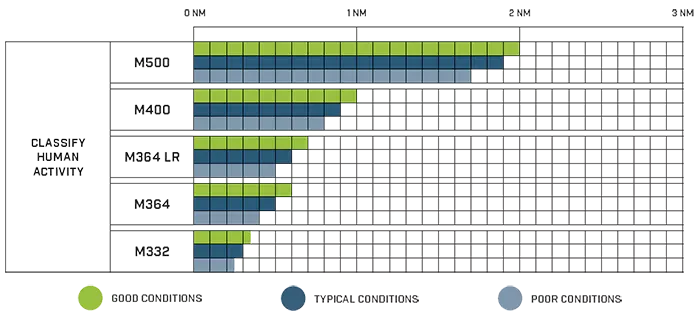
Cooled thermal cameras are invaluable for:
With cooled technology, you get longer reaction times and better decision-making in critical situations.
Whether you choose a cost-effective uncooled camera for shorter distances or a cooled camera for maximum performance, FLIR Marine thermal cameras provide superior visibility, increased safety and reliable detection – day or night .