
 Svenska
 Dansk
Dansk
 Suomi
Suomi
 Español
 Deutsch
 Français
 Italiano
 Nederlands
 Polskie
 Norsk
Norsk
Cart
Your cart is empty, but doesn't have to be..
Discount: 0.00 EUR
Digital Skipper |28/03, 2025
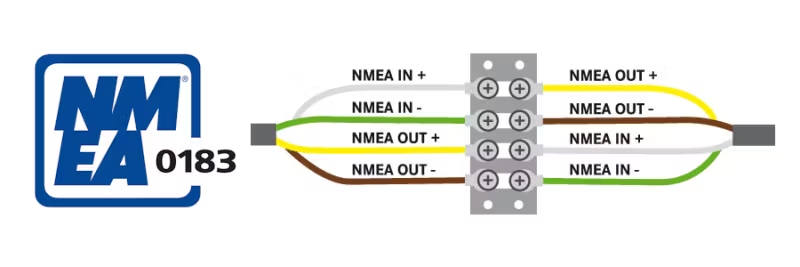
NMEA 0183 is an international standard that enables communication between marine electronic devices. It is used by everything from GPS units to autopilots and fishfinders and is a cornerstone of modern marine electronics. In this guide, we explain what NMEA 0183 is, how it works, common sentences, and why the standard is so important for boat owners and installers.
NMEA stands for National Marine Electronics Association. Standard 0183 defines a common language that marine devices use to exchange data. This allows products from different manufacturers to work together without compatibility issues.
NMEA 0183 uses a serial communication protocol where data is sent as text strings, called sentences. Each sentence begins with a $ character and ends with a checksum to ensure data integrity.
$GPGGA,123519,4807.038,N,01131.000,E,1,08,0.9,545.4,M,46.9,M,,*47
This sentence contains GPS position, time, latitude, longitude, and altitude.
Here are the 10 most common NMEA 0183 abbreviations:
The standard enables interoperability between devices from different manufacturers. A GPS from one Brand can communicate with an autopilot from another, providing flexibility and easy integration into marine systems.
NMEA 0183 now uses RS422 differential drive for better interference protection and longer cable lengths. Originally, it was single-ended, but was updated to meet modern requirements.
Although NMEA 2000 is taking over with higher speeds and more features, NMEA 0183 will continue to be relevant for older systems and simpler installations for many years to come.